Use it!
Step by Step Guide
Working with documentary films in schools can be a valuable and engaging educational tool for teachers and students alike.
If you don’t have previous experience in using documentary films as a teaching resource, on this page a step-by-step guide will help you get started.
Be aware! Documentaries can stir emotions! Get ready! Each step will be explained in detail.
The MAGIC methodology was developed using social impact-driven auteur documentaries made for artistic purposes. It is suggested that a joint assessment of needs and opportunities between pupils; teachers and the school should determine the final choice of the documentary film.
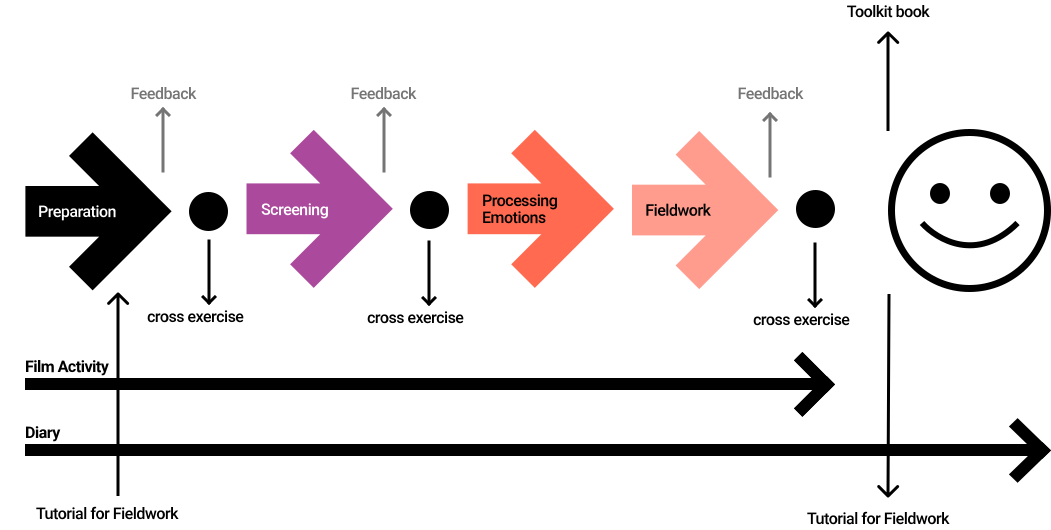
In our experience, documentaries that give a sensitive and sensual portrayal of segments of reality with loveable, real-life protagonists may be an excellent means of teaching tolerance, in the struggle against prejudiced attitudes and negative discrimination. With a comprehensible story, the viewer identifies with the protagonist, imagining his situation, starting to like her, and learning to treat differences as values in both cases. Based on this effect our partnership elaborated a methodology which can inspire you following the step by step description above.
Preparation
The proper film selection? But how?
The first step in preparation is to choose the right film. It is worthwhile to do research on the socio-cultural context, the school syllabus, the curriculum and the needs of the students. We help you do this.
The Resources page lists festivals and professional organisations to contact for advice.
Before the film is shown, the teacher should watch the film. This will help you to decide, for example, whether there are any students in your class who are concerned about the issue in the film. You should also be prepared for their possible reactions.
With the Magic Method it makes sense to plan for the long term. It is recommended to start using the documentary film as an artistic tool from the beginning of the secondary school. This way, the feedback collected at each session can be used to measure the development of a student’s competences.
Watching a documentary together is a shared experience. It can be a good starting point for discussing difficult topics with students.
Documentaries can help to convey information, to change students’ attitudes and to get students involved.
To assess the school environment, we have developed a school survey form which can be accessed here:
The student interest form helps the teacher to choose a film that not only fits the curriculum, but also stimulates the students’ curiosity, making it easier to work with. The form can be found here.
Choosing the right film for your curriculum can sometimes be a challenge. To help you choose the right film, we have developed a set of criteria.
Films we worked with:
Bulgaria: Bayer and the Bees
The school: The National Vocational School of Veterinary Medicine “Prof. Dr. D. Dimov ” Lovech is the oldest veterinary school in Bulgaria.
The pilot screenings and sessions took place in the class of English and biology teachers.
Lithuania: Seahorse, 2020, 16’, DE, directed by Nele Dehnenkamp, trailer:
The school: Priekulė’s Ieva Simonaitytė gymnasium employs 72 teachers, among them 5 specialists: psychologist, social pedagogues, speech therapist, special pedagogue. There are 3 leaders who take care of the Social and Emotional Education of the whole school. 2 teachers were involved in the project, the focus of the school (in the pedagogical program) is students’ emotional development.
They worked on the pilot together with Inconvenient Film Festival.
Hungary: Divas (Dívák), 2021, 89′, HU, directed by Máté Kőrösi, trailer:
Kürt Alternative Gymnasium, It is a private school, the children receive a very democratic education. The children, teachers and parents have a lot of insight into the school’s life and have the opportunity to have a say in the way the schoolwork. The pilot was implemented in English lessons, Danish lessons and Drama lessons.
Nederland: The Circle, 2019, 15’, UK, directed by Lanre Malaolu, trailer:
The pilot training sessions were led by trainers from two organizations. SKVR is an institution that is specializing in art education. They provided training to their own students and to external secondary schools.
Four teachers are involved in the pilot programme, the head of the institute, a cultural anthropologist, a drama teacher and a documentary film director, who worked closely with the trainer from Changes and Chances.
Feedback
Reflection – Feedback – Impact
“Reflection is crucial in the successful process of learning – we need to allow the students to reflect on how they are proceeding to their goals. Learning happens not because of the experience itself, – you should take time and effort to reflect on it, concerning not only your acting but your thinking and feeling during the process as well. We learn the best by verbalizing our experiences. Reflection is an essential part of quality feedback.” – from Students’ Feedback Manual
Students need to have an opinion about the topic they are going to see in the film, and they need to have some kind of attitude towards it. It is worth recording this starting point. It is also worth asking them again after each step to see how and to what extent their attitude has changed. Suggested questions are shown in the infographic.
It is important to create a safe atmosphere during the survey. In our experience, students are curious, especially if the teacher has asked for their opinion on the topic beforehand.
Screening
We came to the screening, which, if we had sat up for it, would have been a special occasion. It’s worth paying attention not only to the subject matter of the film, but also to the cinematic tools, i.e. how the film presents its subject. However, we will now give some viewpoints on the issue presented in the film.
By telling the students in advance what aspects to look out for, we can help them to work on the film later. If we want to know how the film has affected the students, it is best to start the screening without any introductory text that might have an influence on the students during their viewing of the film.
Venue: there can be many different venues, but it is worth considering the conditions: a classroom, a cinema or even an alternative venue. Each venue has its advantages and disadvantages. These should be considered beforehand.
Circumstance: The screening can be an individual event organised by the teacher or a joint programme with a festival.
If you are screening in a classroom, we recommend rearranging the room, moving the tables to the side of the room and arranging the chairs in rows as you would in a cinema. This will break up the usual seating arrangement. It will also help to make the screening a special event. If there are also exercises immediately after the screening, it is easier to pull the chairs apart to make the space larger.
Right: A documentary is a copyrighted work of authorship. We should always try to respect this. Experience has shown that rights holders are happy to give their film to the public for a single screening for educational purposes. Involve the director. Talking to him or her can give students a new perspective.
The screening rights can be obtained from the producer, director or distributor of the film. On the Resources page, we have gathered a list of film collections, festivals and professional organizations to contact.
Processing emotions
The film evoked some kind of emotion from all students: enthusiasm, indignation, boredom. All emotions are equally important. Often the students who said they were bored at the beginning are the ones who are most active in processing the film. They may not have been able to articulate exactly what emotion the film made them feel, they may have been embarrassed or really bored. All this information is important to be able to work successfully with the students.
It is important that participation in the session is voluntary, and sometimes we ask those who have chosen not to participate at the beginning if they would like to join.
It is also worth asking for feedback from students after the screening and after the session. If a similar survey is carried out at the beginning of the process, during the preparation for the topic and the screening, it will be possible to see whether the students’ attitude towards the issue has changed since the beginning.
An example of how we can assess students’ attitudes to the topic. This exercise was used in the implementation of the project. In each case, the questions are chosen by the teacher according to what he or she wants to know about the subject of the film.
We draw a symbolic circle on the floor of the classroom and divide it into 4 parts. Each part represents an opinion, for example: 1, I don’t like cheese, 2, there are cheeses I like, 3, I like cheese, 4, I would always eat cheese.
We ask the students to stand in the section of the circle that applies to them and then record their opinion. This could be a photo or a record of the number of the sector.
This exercise will be repeated during the preparation, after the film, after the processing and finally after the field exercise.
There are different ways of working with the themes seen in the film, and the MAGIC project looked for artistic means to bring out the emotions evoked by the film.
See what our teachers did in
Lithuania Hungary
Bulgaria Netherlands
Fieldwork
One of the biggest benefits of fieldwork is that it engages students. It also enables students to gain hands-on experience with the small slice of reality they have seen in the film.
Be prepared that this unusual task may not be comfortable for everyone at first. It is worth discussing the possibilities with students. For example, students will be more comfortable and successful in their fieldwork if, after watching a documentary on homelessness, they have a variety of options to choose from related to the topic. Such options might include: Visiting a homeless shelter, volunteering to distribute food, or collecting and donating clothes.
It is important to clarify beforehand what role the teacher intends the fieldwork to play in the process. It is also worth clarifying in advance what the students will be doing in relation to the fieldwork. How the institutions to be visited will be selected and who will contact them.
Our experience shows that direct experience and personal encounters can put the social issue seen in the film into a completely new perspective.
After the fieldwork and as a conclusion to the whole process, it is also worth taking time to discuss the experiences with the community (class). It is suggested that everyone looks back on the process, their own initial feelings and how they feel now. What has changed?
More specifically, here are the core competencies you may develop with the MAGIC method.
Knowledge, Critical thinking, Media literacy, Empathy, Communication skills, Research, Cross-curricular connections, Ethical awareness, Global awareness, Creative expression, Cultural competence, Historical inquiry, Environmental awareness, Social justice awareness, Civic engagement, Film aesthetics knowledge, Awareness and knowledge of film language